Support our educational content for free when you purchase through links on our site. Learn more

15 Quick Stress Reduction Techniques for Adults 🌿

The best quick stress reduction techniques for adults are the ones you can use right now: try a comfortable longer exhale, ground yourself in your senses, move gently, or reach out to someone you trust. You don’t have to feel completely calm for a short pause to help you notice what’s happening and choose your next step.
We’ve all had the “one more email” moment when our shoulders are practically auditioning for the role of earrings. A brief reset—loosening your jaw, looking away from the screen, or taking a short walk—can make room between the stress and your response.
There’s no single trick that works for everyone, and quick techniques can’t solve every source of stress. Think of them as tools in a pocket: pick the one that fits the moment, and seek additional support when stress keeps disrupting daily life.
Key Takeaways
- Start with what feels doable: Try gentle breathing, sensory grounding, movement, or a supportive conversation.
- Match the technique to your stress response: Restlessness may call for movement; racing thoughts may benefit from grounding or writing down one next step.
- Keep it comfortable and safe: Don’t force deep breaths or breath holds, and avoid distracting exercises while driving or doing hazardous tasks.
- Short practices are tools, not cures: Persistent or severe stress may need practical changes or professional support.
Table of Contents
- ⚡ Quick Tips and Facts
- 🧠 The Stress Response: Why Quick Relief Can Help
- ⏱️ What’s the Fastest Way to Reduce Stress?
- 🔎 Spot Stress Early: Common Signs in Adults
- 🧭 Understand Your Stress Response
- Fight, Flight, Freeze, and Fawn
- When You Feel Frozen or Shut Down
- 🌿 15 Quick Stress Reduction Techniques for Adults
- 1. Try a Longer-Exhale Breathing Exercise
- 2. Use the 5-4-3-2-1 Grounding Technique
- 3. Relax Your Jaw, Shoulders, and Hands
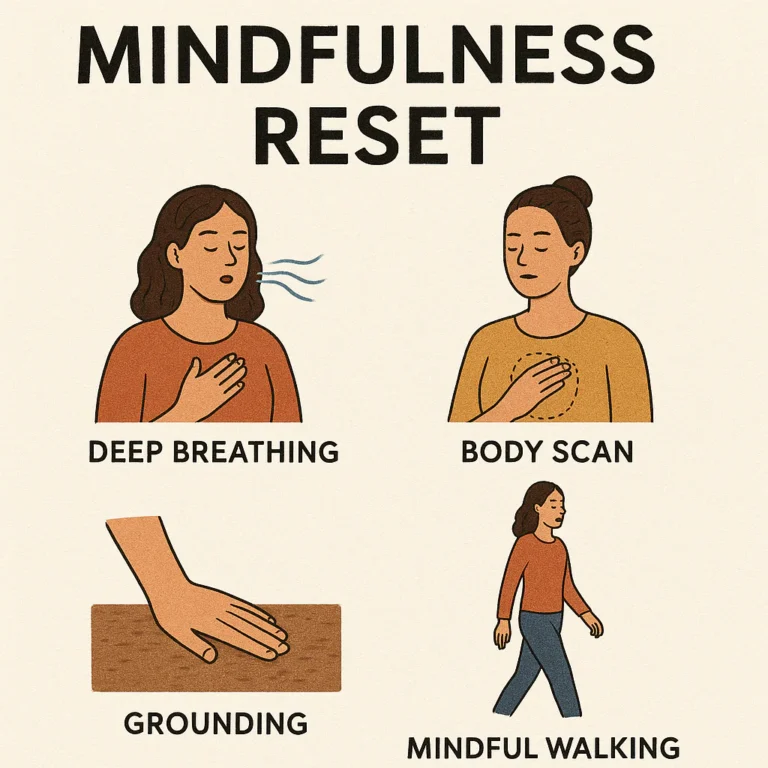
- 4. Practice a One-Minute Body Scan
- 5. Move Your Body for a Few Minutes
- 6. Step Outside or Look at Something Natural
- 7. Use Sound, Music, or Vocal Toning
- 8. Choose a Calming Scent
- 9. Try a Sothing Texture or Temperature
- 10. Sip Water or Enjoy a Mindful Taste
- 11. Write Down the Worry and One Next Step
- 12. Take a Short Technology Break
- 13. Connect With Someone You Trust
- 14. Tidy One Small Area or Complete One Easy Task
- 15. Use a Compassionate Reassurance Phrase
- 👀 Use Your Senses to Find Fast, Personal Stress Relief
- Sight and Visual Grounding
- Sound and Calming Music
- Smell and Aromatherapy Safety
- Touch, Temperature, and Comfort
- Taste and Mindful Sipping
- Movement and Proprioceptive Grounding
- Vocal Toning, Humming, and Gentle Sighs
- 🏠 Quick Stress Relief at Home
- 💼 Quick Stress Relief at Work
- 🚶 Quick Stress Relief on the Go
- 🔁 Make Fast Stress Relief a Sustainable Habit
- Build a Two-Minute Stress-Relief Routine
- Create a Portable Calm Kit
- Track Triggers and What Actually Helps
- ⚠️ Common Stress-Relief Mistakes to Avoid
- 🩺 When Stress Needs More Than a Quick Technique
- Signs It May Be Time to Seek Professional Support
- How Therapy and Medical Care Can Help
- ❓ Quick Answers to Common Questions
- How Can I Calm Down in 30 Seconds?
- Which Breathing Technique Is Best for Stress?
- Can Quick Stress Relief Lower Cortisol?
- What Helps With Stress at Night?
- ✅ Conclusion
- 🔗 Recommended Links
- 📚 Reference Links
⚡ Quick Tips and Facts
A stressful moment doesn’t always need a perfect plan. Sometimes you need one small action that helps your body settle enough to think clearly. At Mindful Ideas™, we recommend starting with the lowest-effort option that feels safe and doable. For more ways to build mindfulness into ordinary routines, see our guide to quick mindfulness activities for adults.
| Quick fact | What it means for you |
|---|---|
| Stress is a response to a demand or perceived threat. | You may notice changes in your body, mood, attention, or behavior. |
| There is no single fastest technique for everyone. | Try breathing, movement, sensory grounding, or connection, then notice what helps. |
| Short practices can fit into a busy day. | Even a brief pause can interrupt autopilot and create room to choose your next step. |
| A technique should feel tolerable, not like another test to pass. | If focusing on breath makes you more uncomfortable, try walking or naming objects around you. |
| Persistent or severe stress deserves support. | Quick techniques can help in the moment, but they do not replace professional care when needed. |
The National Institute of Mental Health describes stress as the physical or mental response to an external cause. Our practical translation: your body may react before your brain has finished writing the meeting agenda. The goal isn’t to force instant serenity; it’s to give yourself a little more steadiness.
✅ Try this 30-second reset: put both feet on the floor, loosen your jaw, and slowly look around the room. Name three things you see. If you want a breath cue, let your next exhale be a little longer than your inhale, without holding or straining.
🧠 The Stress Response: Why Quick Relief Can Help
Stress can affect attention, sleep, digestion, muscle tension, mood, and behavior. It’s the body’s way of preparing to respond to a challenge. That response can be useful in short bursts, but staying activated for a long time may take a toll. The American Psychological Association’s overview of stress explains how stress can affect both mind and body.
A useful distinction from the National Institute of Mental Health: stress usually has an identifiable cause, while anxiety can persist even when there is no immediate threat. They can overlap, and you don’t have to diagnose yourself before trying a grounding exercise.
| What you might notice | Possible stress signal | A gentle first response |
|---|---|---|
| Tight jaw, raised shoulders, clenched hands | Physical bracing | Relax one muscle group; let your hands rest open |
| Racing thoughts, scattered attention | Mental overload | Write down the next single action |
| Shallow or hurried breathing | Arousal or tension | Breathe comfortably and let the exhale soften |
| Restlessness or irritability | High activation | Walk, stretch, or shake out your arms |
| Numbness, foginess, or feeling stuck | Shutdown or overwhelm | Orient to the room and try small, deliberate movement |
A brief technique is best viewed as a speed bump, not a magic off switch. It may reduce tension enough to help you respond more thoughtfully. It will not necessarily remove the cause of the stress, and that’s okay: sometimes the win is moving from “I can’t handle this” to “I can take the next step.”
Explore more evidence-informed practices in our Meditation Practices and Benefits of Mindfulness categories.
⏱️ What’s the Fastest Way to Reduce Stress?
The fastest approach is usually the one you can start immediately and tolerate comfortably. For one person, that’s a slow exhale; for another, it’s walking outside or calling a trusted friend. The HelpGuide quick stress-relief guide similarly recommends experimenting with the senses and movement because individual responses differ.
Choose a technique that matches your state
| If you feel… | Try first | Why it may fit |
|---|---|---|
| Wired, angry, or restless | A short walk, gentle stretches, or a few longer exhales | Adds movement and a deliberate pause |
| Fogy, withdrawn, or stuck | Stand, look around, name what you see, then move your arms and legs | Combines orientation with gentle activation |
| Overwhelmed by thoughts | Write the worry and one concrete next step | Turns a swirling problem into something more specific |
| Lonely or upset | Send a short message or call someone supportive | Connection can help you feel less alone |
| Trapped in a noisy environment | Use a familiar song or notice a comfortable texture | Gives attention a manageable sensory anchor |
A simple 60-second reset
- Pause safely. If you’re driving, operating equipment, or responsible for someone’s immediate safety, keep your attention on that task.
- Feel a point of contact. Notice your feet on the floor or your back against a chair.
- Orient outward. Look around and name three neutral details: a color, a shape, and an object.
- Release one area. Soften your forehead, unclench your hands, or lower your shoulders.
- Choose one next action. Ask, “What’s the smallest useful thing I can do now?”
If a breathing exercise increases dizziness or panic, stop and return to ordinary, unforced breathing. You can switch to looking around, listening to nearby sounds, or gentle movement. Stress relief should not become a contest in tolerating discomfort.
🔎 Spot Stress Early: Common Signs in Adults
Early signs are useful because they give you more options. We often hear people say, “I didn’t realize how tense I was until my shoulders started complaining.” The body can be a surprisingly honest messenger, even if its delivery style is a clenched jaw.
The NHS guide to stress lists a range of possible emotional, physical, and behavioral signs. These vary from person to person.
A quick self-check
Ask yourself:
- Body: Are my shoulders raised? Is my jaw tight? Am I holding my breath?
- Attention: Am I rereading the same sentence or jumping between tasks?
- Mood: Am I unusually iritable, tearful, restless, or withdrawn?
- Habits: Have I been sleeping, eating, moving, or connecting with others differently?
- Need: Would a pause, practical help, movement, or conversation be useful right now?
Try a 10-second body scan: notice your forehead, jaw, shoulders, hands, stomach, and feet. You don’t need to change anything immediately. First, just collect the information. That small act of noticing is mindfulness in plain clothes.
🧭 Understand Your Stress Response
People respond to pressure differently, and the same person can react differently on different days. One useful popular framework describes fight, flight, freeze, and fawn responses. It can help you describe what you’re noticing, but it is not a diagnosis or a complete explanation of how every nervous system works.
| Response label | What it may feel like | Gentle options to try |
|---|---|---|
| Fight | Irritability, defensiveness, anger, urgency | Pause before replying; relax your hands; walk briskly if safe |
| Flight | Restlessness, avoidance, racing thoughts | Break the task into one small step; take a short movement break |
| Freeze | Feeling stuck, blank, numb, or unable to begin | Orient to your surroundings; start with small movements |
| Fawn | Automatically agreeing or prioritizing everyone else | Take a breath and give yourself time before answering |
Fight, Flight, Freeze, and Fawn
These terms are often used to explain common patterns under threat or pressure. They can be useful shorthand, but avoid using them to label yourself rigidly. A label is a clue, not a verdict. If a response is connected to trauma or feels overwhelming, a qualified mental-health professional can help you explore it safely.
When You Feel Frozen or Shut Down
If you feel spaced out or unable to move, try gently reconnecting with the room rather than demanding that you “snap out of it.”
- Keep your eyes open if that feels comfortable.
- Name where you are and identify a few visible objects.
- Press your feet gently into the floor or feel your hands touching a surface.
- Move one limb slowly, then another.
- If it feels okay, stand or take a few steps.
The National Center for PTSD explains that dissociation can involve feeling disconnected from oneself or one’s surroundings. If experiences like this happen often or cause distress, consider seeking professional guidance rather than relying on self-help alone.
🌿 15 Quick Stress Reduction Techniques for Adults
These techniques are a menu, not homework. Pick one, try it for a short time, and notice what happens. The University of Colorado Boulder’s list of quick stress-reduction ideas includes breathing, movement, music, writing, and connection; the best choice still depends on your preferences and circumstances.
1. Try a Longer-Exhale Breathing Exercise
Sit or stand comfortably. Breathe in gently through your nose if that feels natural, then let the breath out slowly without pushing. Repeat for about one minute, keeping the breath comfortable rather than unusually deep.
- ✅ Good for: A brief pause before a meeting or difficult conversation.
- ❌ Skip or modify it if: Breath focus makes you feel panicky, dizzy, or trapped. Look around and breathe normally instead.
The NHS breathing exercise offers a simple, gentle approach. You do not need to use a complicated count or hold your breath to get started.
2. Use the 5-4-3-2-1 Grounding Technique
Pause and identify:
- 5 things you can see.
- 4 things you can feel.
- 3 things you can hear.
- 2 things you can smell.
- 1 thing you can taste, or one neutral sensation in your mouth.
The sequence is a prompt, not a test. If a sense isn’t available, adapt it. The goal is to bring attention back to the present, not to produce a perfect list.
3. Relax Your Jaw, Shoulders, and Hands
Stress can show up as muscle bracing. Let your teeth part slightly, drop your shoulders, and open your hands. Move slowly; there’s no need to force a stretch.
Tiny experiment: notice how your shoulders feel now, roll them gently once, and notice again. That before-and-after comparison can make subtle tension easier to catch.
4. Practice a One-Minute Body Scan
Move your attention from your forehead down to your feet. At each area, ask: “What sensation is here?” You may notice warmth, tension, pressure, or very little. All are valid answers.
Body scans are used in mindfulness-based practices, but they may not suit everyone. If attention to your body feels uncomfortable, keep your eyes open and focus on objects or sounds instead. Browse our Mental Health resources for more ways to support emotional wellbeing.
5. Move Your Body for a Few Minutes
Walk to another room, stretch gently, march in place, or shake out your hands. If you spend much of the day sitting, movement can offer a natural interruption to the “same chair, same thought, same email” cycle.
The CDC’s physical activity guidance recommends regular movement for adults’ health; a short movement break is not a substitute for a full activity routine, but it can be a practical way to get your body moving.
6. Step Outside or Look at Something Natural
If it’s safe and practical, step outdoors for a few minutes. Otherwise, look at a tree, plant, patch of sky, or nature photograph. Notice one detail: the shape of a leaf, the movement of clouds, or the shifting light.
You don’t need to make a grand escape to a mountain. A window can be enough for a small perspective shift.
7. Use Sound, Music, or Vocal Toning
Play a familiar song, listen to rain or birdsong, or hum softly on a comfortable exhale. A short playlist can make an ordinary break feel more deliberate.
Some people enjoy a steady hum because they feel the vibration in their face or chest. Evidence for specific claims that humming rapidly lowers stress hormones is limited, so treat it as a comforting experiment, not a guaranteed biological treatment.
8. Choose a Calming Scent
Notice a scent you already enjoy: tea, a flower, soap, or fresh air. If you use an essential oil, follow product directions and consider allergies, asthma, pets, children, and shared spaces. Strong scents can bother other people, so subtle is often kinder.
9. Try a Sothing Texture or Temperature
Hold a smooth stone, feel a soft sleeve, wrap yourself in a comfortable layer, or wash your hands with pleasantly warm water. Focus on the sensation for a few breaths.
A cool cloth may feel refreshing to some people, but avoid extreme temperatures and don’t treat wrist cooling as a proven substitute for medical care.
10. Sip Water or Enjoy a Mindful Taste
Take a sip of water or tea and notice temperature, flavor, and the moment of swallowing. If you choose a snack, eat it attentively rather than using food as an automatic response to every stressful feeling.
The NHS Eatwell Guide offers general guidance on balanced eating. No snack or drink is a guaranteed stress treatment.
11. Write Down the Worry and One Next Step
Use a note app or paper. Write:
- What’s bothering me?
- What can I influence?
- What is one small next step?
This doesn’t mean every stressor can be solved immediately. It helps distinguish an actionable problem from a thought loop that needs a different kind of support.
12. Take a Short Technology Break
Set your phone face down for a few minutes, mute nonessential alerts, or look away from your screen. If you’re waiting in line or between appointments, notice your surroundings instead of reflexively opening an app.
A digital pause is not a moral achievement. If you rely on your phone for safety, accessibility, caregiving, or work, adjust the break to fit your real needs.
13. Connect With Someone You Trust
Send a simple message: “I’m having a stressful day. Could you listen for a few minutes?” You don’t have to ask the other person to fix everything. Often, clear and kind listening is the useful part.
The U.S. Surgeon General’s advisory on social connection discusses the importance of social connection to health and wellbeing. If you don’t have someone available right now, a supportive community group or professional may be another option.
14. Tidy One Small Area or Complete One Easy Task
Clear one corner of your desk, rinse one cup, or prepare the document you need for your next task. Choose a task small enough to finish without turning it into a full-scale home renovation.
This technique may help when a practical loose end is contributing to your stress. If you’re exhausted, rest may be a better next step than more productivity.
15. Use a Compassionate Reassurance Phrase
Try a sentence that feels believable, not artificially cheerful:
- “This is uncomfortable, and I can take one step.”
- “I don’t have to solve everything in this minute.”
- “I can ask for help.”
- “I’m allowed to pause before I respond.”
Self-compassion is not pretending a problem is fine. It’s responding to yourself with the steadiness you might offer a friend.
👀 Use Your Senses to Find Fast, Personal Stress Relief
The HelpGuide guide to quick stress relief recommends using sight, sound, smell, taste, touch, and movement as possible ways to shift attention. We agree with the broad principle, with one caveat: sensory cues are personal. A scent that relaxes your friend may give you a headache; a quiet room may soothe one person and feel isolating to another.
| Sense or cue | Quick experiment | Consider |
|---|---|---|
| Sight | Look at a plant, photo, or distant object | Choose something comfortable to focus on |
| Sound | Play a familiar song or notice ambient sounds | Earbuds may reduce awareness of your surroundings |
| Smell | Notice tea, flowers, or a familiar lotion | Scents can trigger allergies or asthma |
| Touch | Hold a soft fabric or warm mug | Avoid uncomfortable or extreme temperatures |
| Taste | Sip water or savor a small bite | Avoid turning stress into mindless eating |
| Movement | Stretch, walk, or shake out your hands | Adapt to mobility, pain, and safety needs |
Sight and Visual Grounding
Pick one object and describe it silently: color, shape, edges, and position. Or look at something pleasant, such as a photo, plant, or view outdoors. The point is not to pretend everything is wonderful; it’s to give attention one manageable place to land.
Sound and Calming Music
Try a song you already like, a gentle instrumental track, or the sounds around you. Research on music and stress is an active area, but personal response matters: the right track is the one that feels supportive to you. If music makes you more energized in a way you don’t want, choose something quieter or turn it off.
Smell and Aromatherapy Safety
Use familiar, mild scents if they suit you. Essential oils are concentrated products, not automatically harmless just because they come from plants. The National Center for Complementary and Integrative Health’s aromatherapy overview explains that evidence and safety vary by product and use. Avoid applying undiluted oils to skin, and take care around children, pets, and people with respiratory sensitivities.
Touch, Temperature, and Comfort
Try rubbing your palms together, pressing your feet gently into the floor, or feeling a textured object. If you like, hold a warm mug or wrap up in a soft blanket. Keep the sensation pleasant and safe. You are aiming for comfort, not a dramatic sensory shock.
Taste and Mindful Sipping
Take one sip and notice its temperature and flavor. If you’re eating, slow down enough to notice the first bite. This can be a simple way to interrupt autopilot, but it is not a reason to police your eating or judge yourself for wanting comfort food.
Movement and Proprioceptive Grounding
Proprioception is your sense of where your body is and how it’s moving. Pressing your feet into the floor, stretching gently, or walking with attention to each step can make movement feel grounding.
If mobility, pain, or balance affects what’s comfortable, adapt the action: roll your shoulders, open and close your hands, or shift your weight while seated.
Vocal Toning, Humming, and Gentle Sighs
If it feels comfortable and appropriate, hum softly for a few seconds and notice the vibration. You might also make a gentle sigh on an ordinary exhale. Keep it easy; you should not strain your voice or force a breath pattern.
A study published in the International Journal of Environmental Research and Public Health examined Bhramari pranayama, a humming-style breathing practice. Early research is not proof that humming works for everyone or that it reliably changes particular hormone levels. Treat it as an optional relaxation cue, not a medical claim.
🏠 Quick Stress Relief at Home
At home, choose a reset that matches the moment:
- After work: change clothes, wash your hands, and take three unhuried breaths.
- While cooking: notice a color, smell, or texture as you prepare one ingredient.
- During household overwhelm: choose one small surface, not the entire house.
- During conflict: pause before answering; if safe, say, “I need a few minutes to gather my thoughts.”
- At bedtime: dim the lights, reduce stimulating screen use if practical, and try a quiet activity that feels soothing.
If you live with others, you may need a shared plan. A five-minute pause can work better when someone knows you’re taking it rather than interpreting your silence as a mystery novel.
For sleep concerns that persist, see the NHLBI guide to healthy sleep. A quick relaxation exercise can be part of a wind-down routine, but ongoing sleep problems may need clinical advice.
💼 Quick Stress Relief at Work
Workplace stress often has real causes: workload, conflict, lack of control, uncertainty, or an unreasonable schedule. A breathing exercise may help you steady yourself, but it cannot fix an unsafe or unsustainable working environment by itself.
A discreet desk reset
- Put both feet on the floor.
- Let your hands rest rather than gripping your mouse.
- Look away from the screen and notice a few objects in the room.
- Take one comfortable breath, letting the exhale soften.
- Write down the next task and what can wait.
Other options include standing briefly, stretching your fingers, getting water, taking a short walk, or asking a colleague for help prioritizing. The World Health Organization’s guidance on mental health at work discusses the importance of workplace conditions as well as individual support.
✅ Useful boundary phrase: “I can take this on. Which task should I prioritize first?”
That question can turn a vague pile of urgency into a conversation about capacity.
🚶 Quick Stress Relief on the Go
On public transport, in a waiting room, or between errands, keep your practice simple:
- Feel your feet inside your shoes.
- Notice a few colors or shapes around you.
- Listen to nearby sounds without needing to label them good or bad.
- Losen your hands and let your shoulders settle.
- Text someone supportive if a conversation would help.
Safety first: Don’t close your eyes, use headphones that block important sounds, or practice a distracting exercise while driving, cycling, crossing a street, or supervising a hazardous task. If you’re in traffic, wait until safely parked before trying a breathing or movement exercise.
🔁 Make Fast Stress Relief a Sustainable Habit
A technique is more useful when you remember it before you’re completely overwhelmed. The Virtua guide to quick ways to de-stress emphasizes practice and patience. We’d add: keep the practice small enough that you can repeat it on an ordinary day.
Build a Two-Minute Stress-Relief Routine
Try linking a brief reset to a routine you already have:
- After you sit down at your desk: relax your shoulders and name your first task.
- Before opening your inbox: take one comfortable breath and look away from the screen.
- After washing your hands: notice the temperature of the water.
- Before leaving work: write down one thing to pick up tomorrow.
Habit planning works best when it is specific and realistic. Instead of “I’ll be more mindful,” try “After I make tea, I’ll pause for three slow sips.”
Create a Portable Calm Kit
A calm kit can be as simple as a few familiar options:
- A small note with a grounding phrase
- A smooth object or textured fabric
- Earbuds and a playlist, used only where safe
- Unscented hand lotion or a scent you know you tolerate
- A notebook or notes app for a worry-to-next-step list
You don’t need to buy anything. The most useful kit is the one you’ll actually use and that fits your access, health, and sensory needs.
Track Triggers and What Actually Helps
For one week, note the situation, your early signs, what you tried, and whether it helped. Keep it brief:
| Situation | First sign | What I tried | Helpfulness |
|---|---|---|---|
| Back-to-back meetings | Jaw tension | Looked away and stretched | A little |
| Traffic delay | Restlessness | Music while safely parked | Helpful |
| Too many tasks | Scattered attention | Wrote one next step | Helpful |
The point is not to create another performance metric. It’s to discover patterns. If a technique doesn’t help, that’s useful information, not a personal failure.
⚠️ Common Stress-Relief Mistakes to Avoid
✅ Try: experimenting with a few techniques and noticing your response.
❌ Avoid: insisting that one method must work for everyone.
Other common traps:
- Taking an enormous breath: For some people, forced deep breathing feels uncomfortable. Keep breaths natural.
- Using breath holds when they don’t feel safe: Choose an unheld, comfortable rhythm instead.
- Turning a short practice into a productivity demand: You’re allowed to pause without earning it.
- Using a quick technique to ignore a persistent problem: A reset can help you cope; it may not resolve a harmful workload, relationship, or health concern.
- Assuming “natural” products are risk-free: Scents and supplements can have side effects or interact with health conditions.
- Expecting immediate calm: Sometimes success is simply noticing your stress and responding with more care.
The NCCIH overview of relaxation techniques notes that relaxation approaches are generally intended to support wellbeing, but they are not substitutes for medical treatment. If a practice makes you feel worse, stop and try a different approach.
🩺 When Stress Needs More Than a Quick Technique
Quick strategies can support you through a difficult moment. They are not a substitute for help when stress becomes persistent, severe, or disruptive. Consider talking with a healthcare professional if distress is interfering with sleep, work, relationships, daily responsibilities, or your sense of safety.
Signs It May Be Time to Seek Professional Support
Reach out to a clinician if you experience ongoing anxiety, low mood, panic, frequent physical symptoms, trauma-related distress, substance-use concerns, or difficulty managing day-to-day life. A primary-care provider can help assess possible medical factors and discuss next steps.
If you may hurt yourself or someone else, or you’re in immediate danger, seek urgent help. In the United States, call or text 988 for the 988 Suicide & Crisis Lifeline. For immediate danger or a medical emergency, contact local emergency services.
How Therapy and Medical Care Can Help
A licensed mental-health professional can help identify stress patterns, build coping skills, and address underlying concerns. Approaches such as cognitive behavioral therapy may be appropriate for some people; a qualified clinician can discuss options based on your situation. Learn more about mental-health support through our Mental Health category.
When choosing a therapist, check credentials, areas of expertise, availability, cost and insurance arrangements, and whether you feel respected in the first conversation. You deserve care that fits you, not pressure to adopt a technique or provider that doesn’t.
❓ Quick Answers to Common Questions
What are the quickest mindfulness techniques to reduce stress for adults?
Try a brief sensory grounding exercise, a one-minute body scan, a comfortable longer-exhale breath, or mindful walking. Choose the least complicated option for your current situation. For example, if you’re already restless, movement may fit better than sitting still; if your thoughts are racing, naming what you see may offer a clearer anchor.
The Virtua de-stressing guide also suggests mindfulness, breathing, exercise, and writing as short practices. These are options to test, not guaranteed fixes. If one makes you feel worse, stop and choose another.
How can adults calm down quickly during a stressful moment?
First, make sure you’re physically safe. Then orient to your surroundings, release one area of muscle tension, and choose one small next action. If you have someone supportive available, asking them to listen may be more useful than trying to handle the moment alone.
If you feel panicky, don’t force deep breaths or breath holds. Keep breathing naturally and focus on an external cue, such as the floor beneath your feet or the color of an object.
What breathing exercises help adults relieve stress in just a few minutes?
A comfortable slow-breath practice is a simple place to begin: breathe in gently, then allow the exhale to be slightly longer. Continue briefly without forcing the pace. The NHS breathing exercise provides another guided option.
Square breathing—inhaling, holding, exhaling, and holding for equal counts—is used by some people, but it isn’t the best fit for everyone. If breath holds feel uncomfortable, skip them. If breath-focused exercises trigger dizziness or distress, return to your natural breathing and use grounding or movement instead.
Can a short mindfulness practice reduce stress during a busy workday?
A short pause may help you notice tension, refocus, and choose your response. Try one minute away from your screen, a few gentle shoulder rolls, or naming your next task before reopening your inbox. The WHO’s mental-health-at-work resource also underscores that individual techniques work best alongside attention to workplace conditions.
A mindfulness break cannot compensate for chronic overload or an unsafe workplace. If the stressor is ongoing, consider discussing priorities, boundaries, accommodations, or professional support.
What if breathing exercises make me feel more stressed?
Stop the exercise. Breathe normally, keep your eyes open if that helps, and shift attention outward: name objects, listen to ambient sounds, or feel your feet against the floor. Some people find body-focused exercises uncomfortable, especially during panic or trauma-related distress. There is no requirement to persist.
If this happens regularly, a mental-health professional can help you find approaches that feel safer and more useful.
Do quick stress-relief techniques lower cortisol?
Some articles make strong claims about specific activities changing cortisol. Stress hormones are complex, and effects vary by person, situation, and research method. A brief technique may help you feel calmer, but we wouldn’t promise that a particular hum, snack, or breathing pattern will reliably lower your cortisol.
For understandable background, see the Endocrine Society’s explanation of cortisol. Focus on practical outcomes you can notice—such as feeling less tense or more able to concentrate—rather than assuming a hormone change.
What quick stress relief can I use at work or while commuting?
At work, try grounding through your feet, relaxing your hands, or writing one next step. While commuting, use a technique that keeps you attentive to your surroundings: listen to music at a safe volume on public transit, notice the view, or wait until you are parked before practicing a more focused exercise.
Never use a distracting technique while driving or doing another task that requires your full attention. Safety is part of stress relief.
Is a quick technique enough for chronic stress?
Usually, it’s only one part of the picture. A brief reset may help you through an immediate moment, while persistent stress may call for changes in workload, relationships, health care, sleep support, or professional counseling. If distress is affecting daily life, contact a healthcare provider or licensed mental-health professional.
A perspective from a short movement-and-mindfulness video
The featured three-minute movement exercise offers a practical sequence: rate your tension, breathe, move your shoulders and head gently, shake out your limbs, and finish with a grounding forward fold. Its presenter says, “stress is the aspect of anxiety that we feel in our body,” and, “we can train our mind and our body to be calm.”
We like the emphasis on noticing tension and using movement, especially for people who sit for long stretches. One helpful qualification: definitions of stress and anxiety vary across clinical sources, and the video’s BetterHelp sponsorship is worth knowing when weighing its perspective. Treat the exercise as an optional demonstration, not a diagnosis or a replacement for care.