Support our educational content for free when you purchase through links on our site. Learn more

12 Mindfulness Exercises for Work Stress Relief 🧘

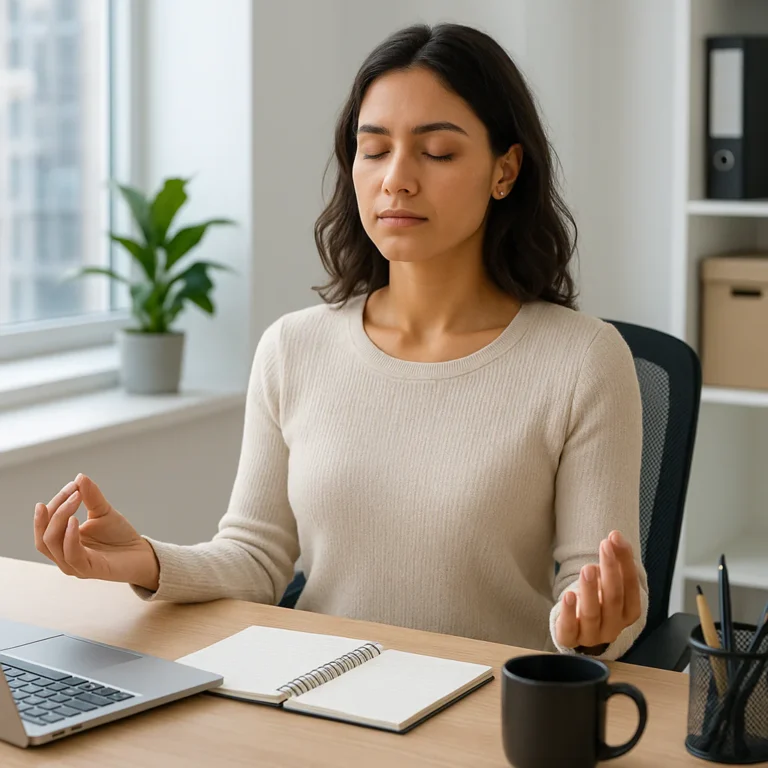
The simplest mindfulness exercises for stress relief at work are brief and practical: notice a few natural breaths, ground yourself in what you can see and feel, or pause to release tension in your shoulders and jaw. If you’re wondering, “What are some simple mindfulness exercises for stress relief that can be done at work?”, you can start right at your desk—no special equipment, quiet room, or perfectly peaceful mind required.
We’ve coached people through all kinds of workday resets, from a quiet breath before a difficult meeting to noticing the feel of their feet during a hectic shift. One useful finding from small pilot studies with nurses: brief guided meditations were associated with some improvements in break recovery, though they’re not a substitute for proper breaks or healthier working conditions (research summary).
Below, we share 12 discreet exercises, with options for busy offices, remote work, and moments when focusing on your breath doesn’t feel comfortable. Pick the one that feels easiest to try—and let that be enough for today.
Key Takeaways
- Try a small reset: mindful breathing, sensory grounding, a desk-based body scan, or a mindful walk can take 30 seconds to five minutes.
- Choose what feels comfortable: if focusing inward or counting breaths feels unpleasant, notice sounds, colors, or your feet on the floor instead.
- Mindfulness isn’t about clearing your mind or forcing calm. It’s practising awareness and gently returning attention when it wanders.
- A brief exercise can support a break, but it can’t replace one. Rest and healthy workplace conditions matter too.
- Start with one exercise: try it before a meeting, after a task, or during a genuine break, then notice whether it helps.
Table of Contents
- ⚡️ Quick Tips and Facts
- 🧠 What Workplace Mindfulness Means for Stress Relief
- How Mindfulness Can Help During the Workday
- What Mindfulness Can—and Cannot—Do for Stress
- 📚 The Roots of Mindfulness at Work
- 🧘 12 Simple Mindfulness Exercises You Can Do at Work
- 1. One-Minute Mindful Breathing
- 2. Box Breathing for a Busy Moment
- 3. The 5-4-3-2-1 Grounding Exercise
- 4. Desk-Based Body Scan
- 5. Mindful Shoulder and Jaw Release
- 6. Three-Minute Mindfulness Pause
- 7. Mindful Walking to the Printer or Kitchen
- 8. Mindful Sipping: Tea, Coffee, or Water
- 9. Mindful Stretching Between Tasks
- 10. One-Task-at-a-Time Focus Reset
- 11. A Quick Gratitude or “What’s Going Well?” Check-In
- 12. Mindful Transition Ritual After a Meeting
- ⏱️ Choose an Exercise by Time, Place, and Stress Level
- 30-Second Mindfulness Resets
- Five-Minute Stress-Relief Breaks
- Quiet, Private, and Camera-Friendly Options
- 💻 Mindfulness Exercises for Remote and Hybrid Work
- 🗓️ How to Build a Practical Workplace Mindfulness Routine
- Mindfulness Triggers: Meetings, Emails, and Task Changes
- A Simple Daily Schedule for Mindful Breaks
- 🧩 Making Mindfulness Work for Different Jobs and Workplaces
- Open Offices and Shared Workspaces
- Customer-Facing, Shift, and High-Pressure Roles
- Accessibility and Personal Preferences
- 🚧 Common Mindfulness Mistakes—and How to Fix Them
- ❓ Workplace Mindfulness FAQs
- How often should I practise mindfulness at work?
- Can I practise mindfulness without closing my eyes?
- What if breathing exercises make me feel uncomfortable?
- Can mindfulness help with work anxiety or burnout?
- How can managers support mindfulness without adding pressure?
- 🔎 Conclusion
- 🔗 Recommended Links
- 📖 Reference Links
⚡️ Quick Tips and Facts
- You don’t need a meditation room, a singing bowl, or a suspiciously serene fern. Most workplace mindfulness exercises take 30 seconds to five minutes and can be done at a desk, in a hallway, or while walking to refill your water.
- For more short, everyday ideas, see our guide to quick mindfulness activities for adults.
- Start with what feels comfortable: notice your breathing without changing it, feel your feet on the floor, or identify details in the room. If focusing on your breath feels unpleasant, choose an external anchor such as sounds or colors.
- Mindfulness isn’t about emptying your mind. It’s practising attention to what’s happening now, then gently returning when thoughts wander.
- A short pilot study with nurses found that successful, audio-guided meditation during breaks was associated with better break recovery. The results were small to medium and preliminary, not proof that a brief exercise fixes workplace stress. The researchers also stressed that meditation should not replace adequate breaks or better working conditions. (Study details)
- The British Heart Foundation describes slow breathing as a practical way to ease tension, while noting that some techniques have less research behind them than others. (BHF breathing exercises)
- A sensible first try: take six comfortable breaths, notice your shoulders and jaw, then decide whether you feel ready to return to the task—or need a real break.
| If you have… | Try… | Time |
|---|---|---|
| A packed calendar | One mindful exhale before joining a call | 10–20 seconds |
| Racing thoughts | 5-4-3-2-1 sensory grounding | 1–2 minutes |
| A stiff neck or clenched jaw | Seated body check and gentle release | 1–3 minutes |
| A proper break | Three-minute breathing space or mindful walk | 3–5 minutes |
| Discomfort focusing inward | Mindful listening or mindful seeing | 1–3 minutes |
🧠 What Workplace Mindfulness Means for Stress Relief
Mindfulness at work means paying attention to the present moment with curiosity rather than judgment. That might mean noticing your breath before you answer a tense email, listening closely in a meeting, or feeling your feet on the floor when a deadline starts to loom.
It isn’t a demand to be calm all the time. You can be mindful and still feel irritated, worried, or busy. The practice is to notice what’s happening and choose your next step with a little more awareness.
How Mindfulness Can Help During the Workday
Work stress often pulls attention in several directions at once: the message you haven’t answered, the meeting you’re in, and the task you’re already late to start. A brief mindfulness pause offers a chance to notice that mental pile-up and return attention to one thing.
Potential benefits include:
- A pause between a feeling and a reaction: notice tension before replying sharply or sending an email you’d rather retrieve.
- More deliberate attention: return to the conversation or task in front of you instead of rehearsing the next five.
- A clearer transition between tasks: let one meeting finish mentally before carrying it into the next.
- A more restorative break: give your attention somewhere other than work for a few minutes.
Research on brief workplace meditations is promising but still limited. In two small pilot studies with nurses, short guided meditations were associated with aspects of better recovery, including feeling calmer after a break and greater detachment from work after the workday. The findings do not establish that every exercise works for every person, or that mindfulness can compensate for inadequate staffing and skipped breaks. (Pilot-study report)
For more on mindfulness and wellbeing, explore our Benefits of Mindfulness and Mental Health resources.
What Mindfulness Can—and Cannot—Do for Stress
Mindfulness can help you work with a stressful moment. It cannot remove an unreasonable workload, repair a hostile workplace, or replace mental-health care.
| Mindfulness may help you… | It cannot reliably… |
|---|---|
| Notice stress signals and pause | Make a harmful work environment healthy |
| Refocus one manageable next step | Guarantee calm or productivity |
| Practise nonjudgmental awareness | Stop thoughts from appearing |
| Add a short recovery ritual to a break | Replace a break, lunch, or time away from work |
| Explore a self-care skill | Substitute for professional support when you need it |
A useful distinction: mindfulness is a personal practice; workplace wellbeing is also a structural responsibility. The nurses’ study authors emphasize that workplaces need breaks of appropriate duration and conditions that make them possible—not just an audio track and a pair of headphones. (Study discussion)
📚 The Roots of Mindfulness at Work
Mindfulness has roots in contemplative traditions, and it is now also studied and taught in secular settings. In everyday workplace practice, it generally means intentionally noticing what is happening in the present—thoughts, sensations, sounds, and surroundings—without immediately judging or reacting to it.
That sounds simple. The tricky part is that attention wanders. You notice a breath, remember an overdue form, and suddenly your mind is conducting a full committee meeting about the week. Returning attention is the exercise. Wandering isn’t a failure.
A recent pilot study of nurses tested short audio-guided practices lasting about seven to eight minutes, including attention to breathing, bodily sensations, thoughts, and sounds. Participants could choose among different approaches. That detail matters: mindfulness doesn’t have to mean sitting still and concentrating on breath. An external sound or a body sensation may be a better fit for some people. (Study methods and findings)
The first video’s approach also emphasizes ordinary moments: noticing the environment while waiting, attending to sensory details, listening fully, and doing one task at a time. Its useful reminder is to focus on the task itself, rather than merely trying to get the task over with. Watch the video.
🧘 12 Simple Mindfulness Exercises You Can Do at Work
Choose one practice and try it once before deciding whether it suits you. You’re not looking for a dramatic transformation. A small shift—less jaw clenching, a clearer next step, or simply noticing that you’re overwhelmed—counts.
1. One-Minute Mindful Breathing
Best for: a quick reset between tasks.
- Sit or stand in a position that feels comfortable.
- Let your gaze rest one spot, or soften your eyes.
- Notice the breath at the nose, chest, or belly—wherever it’s easiest to feel.
- Take six natural breaths. Don’t force them to be deep or slow.
- When attention wanders, notice that and gently return to one breath.
- Before restarting work, ask: “What is the next thing I need to do?”
Why it can help: breath provides a simple point of attention when the mind is jumping ahead. The goal isn’t to control every breath; it’s to practise coming back.
A note from our coaching practice: We often suggest starting with natural breathing rather than a fixed count. Counting can feel supportive for some people and restrictive for others. You get to choose.
2. Box Breathing for a Busy Moment
Best for: a brief, structured breathing pause before a call or presentation.
- Sit or stand comfortably and release your shoulders.
- Breathe in gently for a count of four.
- Pause for four counts only if holding your breath feels comfortable.
- Breathe out gently for four counts.
- Pause again for four counts if comfortable.
- Repeat for two to four rounds, then return to normal breathing.
The British Heart Foundation describes box breathing as a four-part pattern: inhale, hold, exhale, hold. (BHF instructions)
Make it easier: use shorter counts, skip the holds, or switch to simply noticing each exhale. Stop if you feel dizzy, short of breath, or uncomfortable. Breath holds aren’t compulsory mindfulness homework.
3. The 5-4-3-2-1 Grounding Exercise
Best for: feeling scattered or caught in a worry spiral.
Quietly identify:
- 5 things you can see—a window frame, a blue folder, light on a wall.
- 4 things you can feel—your feet in your shoes, your hand on the desk, the chair supporting you.
- 3 things you can hear—a fan, distant conversation, traffic.
- 2 things you can smell—coffee, soap, or simply the air around you.
- 1 thing you can taste—a sip of water or the lingering taste in your mouth.
You don’t need to find especially interesting details. The point is to bring attention to immediate sensory information. If the full sequence feels like too much, choose just one category—such as three sounds—and stay with it.
4. Desk-Based Body Scan
Best for: catching physical tension before it becomes your default posture.
- Keep your eyes open or closed—whichever feels more comfortable.
- Notice your feet touching the floor.
- Move attention slowly to your calves, thighs, hips, and back.
- Check your hands, shoulders, jaw, and forehead.
- Where you notice tension, ask: “Can I soften this a little?” Don’t force relaxation.
- Finish by noticing your whole body sitting or standing in the room.
A complete body scan can be much longer; this is a practical desk-sized version. If focusing on body sensations brings up discomfort, shift attention outward to the room or a steady sound. Mindfulness should be adaptable, not a test of endurance.
5. Mindful Shoulder and Jaw Release
Best for: the classic “my shoulders are now earrings” workday.
- Notice where your shoulders are without criticizing your posture.
- Raise them slightly toward your ears, then let them drop gently.
- Unclench your jaw and let your teeth separate.
- Rest your tongue comfortably and release the muscles around your eyes.
- Take one comfortable breath and notice any change.
Keep movements small and pain-free. This is an awareness exercise, not a substitute for ergonomic adjustments or medical advice if pain persists.
6. Three-Minute Mindfulness Pause
Best for: a break between meetings or tasks.
- Minute 1: Notice. What thoughts, emotions, and body sensations are present? Name them simply: “planning,” “frustration,” “tight shoulders.”
- Minute 2: Attend. Bring attention to a few natural breaths. No need to change them.
- Minute 3: Widen. Notice the body as a whole, then the room around you. Ask what would be helpful next.
This three-part format is a practical adaptation of the “three-minute breathing space” described by PositivePsychology.com. If you have less time, take one minute from each step—or just pause to notice what’s happening.
7. Mindful Walking to the Printer or Kitchen
Best for: a short movement break when sitting still feels unappealing.
- Walk at your usual safe pace.
- Feel your feet touch the ground and lift again.
- Notice one or two sounds around you.
- When your mind plans the next task, gently return to the sensation of walking.
- Reach your destination and pause before switching activities.
You don’t need to walk slowly enough to alarm colleagues. Mindful walking is ordinary walking with some attention brought to it. Stay alert to other people, stairs, traffic, and workplace safety.
8. Mindful Sipping: Tea, Coffee, or Water
Best for: a discreet sensory reset.
- Hold your cup and notice its weight and temperature.
- Look at the color or surface of the drink.
- Notice its scent, if any.
- Take one sip and pay attention to taste and texture.
- Swallow, then notice the aftertaste.
This isn’t a command to turn every coffee into a ceremony. One attentive sip is enough. If caffeine makes you feel jittery, choose water or another drink that works for you.
9. Mindful Stretching Between Tasks
Best for: a short pause that includes gentle movement.
- Stand if that’s comfortable and safe.
- Notice where your body feels stiff.
- Roll your shoulders gently or reach your arms overhead within a pain-free range.
- Feel the stretch and breathe normally.
- Stop or adjust if anything hurts, pulls sharply, or feels unstable.
Mindful stretching combines movement with attention. It’s not a treatment plan for an injury, and there’s no need to copy a pose that doesn’t suit your body.
10. One-Task-at-a-Time Focus Reset
Best for: task switching and the feeling that every open tab is yelling.
- Pause and name what you’re doing now.
- Write down the next task if you’re worried you’ll forget it.
- Close or minimize unrelated windows if practical.
- Choose one small next action: open the document, draft the first sentence, or read the first line.
- When attention moves elsewhere, note it and return to that action.
Mindfulness doesn’t require a perfect, distraction-free office. It can mean noticing distraction and making a deliberate choice about what to attend to next.
11. A Quick Gratitude or “What’s Going Well?” Check-In
Best for: widening attention when a difficult moment is taking up the whole mental screen.
Ask yourself:
- What went adequately today, even if it wasn’t perfect?
- Who helped me with something?
- What’s one thing I’ve completed?
- What small support do I need next?
This is not an instruction to feel grateful for unfair treatment or to talk yourself out of legitimate concerns. You can acknowledge a good moment and still address a real problem.
12. Mindful Transition Ritual After a Meeting
Best for: not carrying the last meeting into the next one.
- Before opening the next task, take a moment to notice how you feel.
- Write down any follow-up you need to remember.
- Take one comfortable breath and feel your feet on the floor.
- Ask: “What belongs to the meeting that just ended, and what needs my attention now?”
- Begin the next task with one clear action.
That tiny transition can be especially useful after a tense conversation. It won’t erase the issue, but it may help you avoid replaying the whole exchange while trying to do something else.
⏱️ Choose an Exercise by Time, Place, and Stress Level
There’s no universal “best” exercise. The most helpful one is the one you can do safely, comfortably, and consistently enough to learn whether it suits you.
| Situation | Good first choice | Why |
|---|---|---|
| You have less than a minute | Feel your feet; notice one exhale | Low effort and discreet |
| Your thoughts are racing | 5-4-3-2-1 grounding | Uses outward sensory attention |
| You’re tense before a meeting | Shoulder and jaw release; natural breathing | Simple, easy to do seated |
| You can take a proper break | Three-minute pause or mindful walk | Gives attention more room to settle |
| Inward focus feels uncomfortable | Mindful listening or mindful seeing | Keeps attention oriented to the surroundings |
| You feel physically tired | Take an actual rest break | Mindfulness is not a substitute for recovery |
30-Second Mindfulness Resets
Try one of these:
- Feel both feet in contact with the floor.
- Name three things you see and one thing you hear.
- Let your jaw soften and your shoulders drop slightly.
- Take one comfortable breath and notice its beginning, middle, and end.
- Pause before clicking “send” and reread the message.
The first video’s everyday approach also recommends using waiting moments to observe nearby details instead of automatically reaching for a phone. That can be a useful prompt when you have a genuine pause—not when you need to pay attention to traffic, equipment, or safety. See the video reference.
Five-Minute Stress-Relief Breaks
If you have five uninterrupted minutes:
- Spend one minute noticing how you feel.
- Take two minutes for a comfortable breathing practice or sensory grounding.
- Use one minute to stretch or walk if that’s suitable.
- Take the final minute to choose a next step—or simply return to your break.
A five-minute exercise only helps if it doesn’t steal the break you need. In the workplace meditation pilot study, short meditations were offered in addition to regular breaks, not as a replacement for them. (Study findings and practical implications)
Quiet, Private, and Camera-Friendly Options
| Need | Try | Keep in mind |
|---|---|---|
| No one should notice | Feel your feet or notice a few breaths | Keep your gaze open if preferred |
| You’re on a video call | Listen to the speaker; notice your posture | Stay engaged and avoid exercises that distract you |
| The office is noisy | Focus one sound or use grounding | Headphones are optional, not a requirement |
| You need a break from screens | Mindful walking or looking out a window | Follow workplace safety and accessibility needs |
| You want privacy | Use a quiet, appropriate space if available | A workplace shouldn’t require disclosure of personal practice |
💻 Mindfulness Exercises for Remote and Hybrid Work
Working from home can remove the commute but blur the line between “work mode” and “I am still answering messages in the kitchen.” A short transition ritual can help mark the edges of the day.
- Before opening email: feel your feet on the floor and choose your first task.
- Between video calls: look away from the screen, notice your shoulders, and take a natural breath.
- At lunch: move away from your work area if you can. Eat without reading every notification for at least a few minutes.
- At the end of the day: write down the next work action, close work materials, and take a mindful walk or stretch.
- If you work in a shared home: choose a discreet anchor—your hands on the desk, sounds in the room, or the feeling of a mug.
The first video’s suggestions about mindful eating, sensory awareness, and one-task-at-a-time attention translate neatly to remote work. Its core idea is to notice ordinary actions without turning them into another performance target. Video reference.
🗓️ How to Build a Practical Workplace Mindfulness Routine
The best routine is usually small enough to survive a busy Tuesday.
Mindfulness Triggers: Meetings, Emails, and Task Changes
Attach a brief practice to something you already do:
- After opening your calendar: notice your posture before choosing a task.
- Before sending a difficult email: take one breath and check your intention.
- After a meeting: write down the next action, then reset.
- Before lunch: leave your desk if possible and pay attention to the first few bites.
- When a notification appears: ask whether it needs attention now.
These cues work because they turn mindfulness into a repeatable pause, rather than another item on an already crowded to-do list.
A Simple Daily Schedule for Mindful Breaks
| Moment | Low-effort practice |
|---|---|
| Start of work | One minute to notice your body and identify a first task |
| Between tasks | One natural breath and a clear transition |
| Mid-morning | Walk, stretch, or take a screen break if possible |
| Before a challenging meeting | Relax jaw and shoulders; listen to the room |
| Lunch or rest break | Give attention to your food, surroundings, or quiet |
| End of work | Note follow-ups and mark a transition out of work |
Treat this as a menu, not a compliance chart. If the day is demanding, protecting an actual break matters more than completing a mindfulness routine.
🧩 Making Mindfulness Work for Different Jobs and Workplaces
Mindfulness practices should adapt to people and working conditions—not the other way around.
Open Offices and Shared Workspaces
- Choose eyes-open practices such as noticing feet, sounds, or a single object.
- Keep exercises short and quiet if a private room isn’t available.
- Use headphones only where permitted and safe.
- Don’t assume a noisy office is a personal failure to concentrate; the environment matters.
Customer-Facing, Shift, and High-Pressure Roles
For jobs with tight turnaround or little control over breaks, a one-breath transition may be more realistic than a seated meditation. But a tiny reset should not be presented as an adequate substitute for rest, safe staffing, or predictable breaks.
The small nurse pilot studies are especially relevant here because they examined brief meditation around work breaks. Their findings support further research, while also highlighting a practical limit: staff need breaks that are long enough and protected from interruption for practices to be used consistently. (Pilot study)
Accessibility and Personal Preferences
You can adapt mindfulness to your needs:
- Keep your eyes open if closing them feels uncomfortable.
- Choose sounds or visual details rather than body sensations.
- Sit, stand, or move in a way that works for your body.
- Skip breath counting or breath holds if they feel unpleasant.
- Use a shorter practice, or stop if distress increases.
There is no single correct posture or sensory anchor. Comfort and choice matter more than performing the exercise “properly.”
🚧 Common Mindfulness Mistakes—and How to Fix Them
| Common snag | A kinder, more useful adjustment |
|---|---|
| “My mind keeps wandering.” | Wandering is normal; gently return attention when you notice it. |
| “I’m supposed to feel calm.” | The aim is awareness, not a guaranteed mood change. |
| “I have no time.” | Try 10–30 seconds, but don’t use the practice to erase a needed break. |
| “Breathing exercises make me uncomfortable.” | Switch to sounds, sight, or contact with the floor. |
| “I missed a day, so I’ve failed.” | Restart when it fits. This isn’t a streak-based sport. |
| “Mindfulness should make this workload manageable.” | Individual practices can’t replace organizational changes or appropriate support. |
If a practice repeatedly causes distress, stop and choose a different grounding approach. If work stress is seriously affecting your health or daily functioning, consider speaking with a qualified health professional or an appropriate workplace support service. Our Mental Health resources offer additional wellbeing reading.
❓ Workplace Mindfulness FAQs

How can I practice mindfulness at work in just five minutes?
Try a three-minute mindfulness pause: spend one minute noticing thoughts and body sensations, one minute attending to natural breathing, and one minute widening awareness to your body and surroundings. Use the remaining time for a glass of water, a gentle stretch, or a clear transition back to work. If you already have a scheduled break, practise within it rather than letting mindfulness replace it.
What if five minutes feels too long?
Start with 30 seconds: feel your feet, notice one breath, or identify three things you see. A shorter practice you’re comfortable trying is more useful than an ambitious routine that adds pressure.
Read more about “25 Quick Mindfulness Activities for Adults 🧘 (2026)”
What breathing exercises can reduce stress during a busy workday?
Start with comfortable natural breathing: notice a few breaths without trying to control them. If you like structure, box breathing uses four equal stages—inhale, pause, exhale, pause—but the breath holds are optional. The British Heart Foundation also outlines 4-7-8 breathing and alternate nostril breathing, while noting that evidence for some methods is limited. (BHF guide)
Can breathing exercises make me dizzy?
They can, particularly if you breathe too deeply or hold your breath for longer than is comfortable. Stop, return to ordinary breathing, and sit down if needed. Don’t push through dizziness or shortness of breath. If you have concerning symptoms or a relevant health condition, seek medical advice.
Read more about “7 Minute Meditation Practices for Instant Calm (2026) 🧘 ♀️”
How can I do a quick mindfulness exercise at my desk?
Place both feet comfortably, notice where your body meets the chair, and scan for tension in your jaw and shoulders. Take a natural breath, then choose one thing to focus on: a sound, an object, or the next work action. The whole reset can take less than a minute, and you can do it with your eyes open.
What if I don’t want colleagues to notice?
Try silent practices: feel your feet on the floor, notice the sound of the air conditioning, or give your full attention to a sip of water. No special posture or visible ritual is required.
Read more about “🌟 What is a Real Life Example of Mindfulness? 7 Instant Practices (2026)”
What mindfulness techniques can help me stay calm during work meetings?
Before the meeting, soften your jaw and shoulders and take one comfortable breath. During the conversation, listen to the speaker rather than rehearsing your response; if your mind races ahead, notice that and return to what’s being said. When it’s your turn, pause briefly before answering. Mindfulness can support a more deliberate response, but it doesn’t require you to hide a concern or agree with someone.
What if the meeting itself is stressful or unsafe?
A grounding exercise may help you stay oriented, but it cannot resolve harassment, discrimination, or other serious workplace problems. Use appropriate support and reporting channels where relevant, and prioritize your safety.
Do short mindfulness exercises at work actually work?
Evidence is encouraging but mixed and still developing. A pair of small pilot studies involving nurses linked brief guided meditations with some aspects of break recovery and after-work wellbeing. The effects were generally small to medium, and evidence for improved attention was limited. These findings justify trying a brief practice if it suits you, but they don’t guarantee a result. (Study report)
Read more about “30 5-Minute Mindfulness Activities 🧘”
Can mindfulness replace a proper work break?
No. Mindfulness can be part of a break, but it doesn’t replace rest, food, movement, or the structural conditions that make breaks possible. The nurse study authors specifically called for appropriate, reliable breaks rather than relying on meditation alone. (Research discussion)
What should I do if mindfulness makes me feel worse?
Stop the exercise and orient to something neutral outside yourself, such as a nearby object, a familiar sound, or the feel of your feet on the floor. You can also skip inward-focused practices altogether. If distress persists or interferes with daily life, consider seeking support from a qualified health professional.
Read more about “25 Mindfulness Meditation Techniques for Anxiety Relief in 2025 🧘 ♂️”