Support our educational content for free when you purchase through links on our site. Learn more

🚀 15 Mindful Ways to Shatter Creative Blocks (2026)

Ever stared at a blank page until your eyes crossed, feeling like your brain has hit a brick wall? You’re not alone. In fact, we’ve all been there—the dreaded creative block, that silent saboteur that whispers, “You have nothing left to give.” But here’s the secret most people miss: the block isn’t a stop sign; it’s a pause button. At Mindful Ideas™, we’ve helped thousands of writers, artists, and dreamers turn that frustration into fuel, not by forcing ideas out, but by learning to listen to the silence between the thoughts.
In this comprehensive guide, we’re going beyond the usual “take a deep breath” advice. We’re diving deep into the neuroscience of stagnation, exploring why your brain hits the wall, and revealing 15 powerful, science-backed mindfulness techniques designed specifically to shatter those blocks. From the “Bad Idea” brainstorm to the transformative power of the “Shower Method,” you’ll discover how to bypass your inner critic and unlock a state of effortless flow. We’ll even share real case studies of top creatives who used these exact methods to turn their worst blocks into their best work. Ready to stop fighting your mind and start collaborating with it? Let’s get unstuck.
Key Takeaways
- Blocks are neurological, not personal: Creative stagnation is often a result of an overactive Executive Control Network suppressing your brain’s natural idea generator, the Default Mode Network.
- Effort is the enemy: Trying harder to be creative often backfires; passive mindfulness and letting go of judgment are the true keys to unlocking flow.
- 15 proven techniques: This article offers a curated list of actionable strategies, from sensory grounding to mindful art therapy, tailored for every type of creator.
- The power of rest: Sleep, stress management, and digital detoxes are not luxuries; they are essential fuel for the creative engine.
- You are not broken: Every creative block is an opportunity to reconnect with your authentic voice and rediscover the joy of creation.
Table of Contents
- ⚡️ Quick Tips and Facts
- 🧠 The History of Creative Blocks: From Muse to Mental Gridlock
- 🚧 Why Your Brain Hits the Wall: Understanding the Science of Stagnation
- 🌿 15 Mindfulness Techniques to Shatter Creative Blocks and Ignite Flow
- 🎨 Mindful Art Therapy: Using Creativity as a Path to Clarity
- 🧘 ♀️ Meditation for Writers, Designers, and Dreamers: Tailored Practices
- 🛌 Sleep, Stress, and the Silent Saboteurs of Your Imagination
- 🍽️ Mindful Eating and Movement: Fueling the Creative Engine
- 📱 Digital Detox: Reclaiming Your Focus in a Noisy World
- 🤝 Cultivating a Mindful Creative Community: You Are Not Alone
- 🛠️ Tools of the Trade: Apps, Journals, and Gear for the Mindful Creator
- 💡 Quick Wins: 5-Minute Mindfulness Hacks for Immediate Inspiration
- 📊 Case Studies: How Top Creatives Overcame the Blank Page
- ❓ Frequently Asked Questions About Mindfulness and Creativity
- 🔗 Recommended Links and Resources
- 📚 Reference Links and Scientific Studies
- 🏁 Conclusion: Your Masterpiece Awaits on the Other Side of the Block
⚡️ Quick Tips and Facts
Before we dive deep into the neuroscience of why your brain decides to take a coffee break right when you need it most, let’s hit the ground running with some actionable truths from the Mindful Ideas™ coaching team. We’ve seen thousands of creatives—from burnt-out copywriters to artists staring at blank canvases—stuck in the same loop. Here is the lowdown:
- The “Eureka” Myth: Contrary to popular belief, your best ideas rarely strike when you are furiously typing or sketching. According to research, passive activities like showering, walking, or driving are where the magic happens because they allow the brain’s Default Mode Network to fire up. Source: Harvard Health Publishing
- The Effort Paradox: Trying too hard to be creative actually shuts down the creative centers of your brain. The brain needs a lower level of mental effort to make spontaneous connections.
- It’s Not a Defect: Creative blocks are not a sign of failure; they are a universal human experience, even for the most celebrated artists in history.
- Mindfulness is the Reset Button: It’s not about emptying your mind; it’s about observing the block without judgment. This simple shift can turn frustration into curiosity.
- Neuroplasticity is Real: Your brain can change. You are not “stuck” forever; you can rewire your neural pathways for creativity at any age.
Did you know? A study on jazz musicians found that during improvisation, the dorsolateral prefrontal cortex (the brain’s “censor”) actually deactivates. This is why “leting go” feels so scary but is so necessary for flow.
🧠 The History of Creative Blocks: From Muse to Mental Gridlock

We often treat creative blocks as a modern invention, a byproduct of our high-pressure, digital world. But the struggle is as old as art itself. The ancient Greeks believed in the Muse—an external deity who granted inspiration. If the Muse wasn’t visiting, you were blocked. It was a spiritual issue, not a psychological one.
Fast forward to the Romantic era, and the narrative shifted. Creativity became internal, a storm of emotion and genius. But with that came the Tortured Artist trope. If you weren’t suffering, were you even creating? This mindset created a toxic link between pain and productivity, making the block feel like a personal failure rather than a natural cycle.
Today, we understand the neuroscience behind the block. It’s not a lack of talent; it’s a neurological bottleneck. When we stress, our brain floods with cortisol, which inhibits the prefrontal cortex—the very area needed for complex problem-solving and idea generation.
The Mindful Shift: At Mindful Ideas™, we reframe the block not as a “wall” but as a pause button. It’s the universe’s way of telling you to recharge your creative batteries. As Ellen Langer, a Harvard Professor, famously noted, “The life well lived is best lived effortlessly… Trying, in many instances, is based on mindless evaluation.”
🚧 Why Your Brain Hits the Wall: Understanding the Science of Stagnation
Why does your brain suddenly decide to play solitaire when you have a deadline? Let’s break down the biology of the block.
The Battle of the Networks
Your brain operates on two main networks that often fight for dominance:
- The Executive Control Network (ECN): This is your “focus” mode. It’s active when you are analyzing, planning, and critiquing. It’s the inner critic.
- The Default Mode Network (DMN): This is your “daydream” mode. It’s active when you are resting, wandering, or letting your mind drift. It’s the inner dreamer.
The Problem: When you are stuck, your ECN is overactive. You are critiquing your ideas before they are even fully formed. You are trying to force a connection that isn’t ready.
The Neuroscience of “Flow”
Research shows that highly creative states occur when there is a seamless handshake between the DMN and the ECN. The DMN generates the wild, random ideas, and the ECN gently shapes them into something usable.
| Brain State | Dominant Network | Result |
|---|---|---|
| Stress/Anxiety | Hyper-active ECN | Over-criticism, paralysis, “I can’t do this.” |
| Distracted | Hyper-active DMN | Daydreaming, lack of focus, no output. |
| Flow State | Balanced ECN & DMN | Effortless creation, timelessness, “Aha!” moments. |
| The Block | ECN suppressing DMN | Stagnation, frustration, mental gridlock. |
The Role of Fear
Often, the block is emotional, not cognitive. It’s fear of failure, fear of judgment, or fear of the unknown. When you feel unsafe, your brain reverts to survival mode, which is the opposite of creative exploration.
The Mindful Insight: You cannot think your way out of a block. You have to feel your way out. By acknowledging the fear without letting it drive the car, you allow the DMN to come back online.
🌿 15 Mindfulness Techniques to Shatter Creative Blocks and Ignite Flow
Ready to get unstuck? We’ve curated 15 powerful mindfulness techniques specifically designed to bypass the inner critic and unlock your creative flow. These aren’t just “sit and breathe” exercises; they are active interventions for the stuck mind.
1. The “Shower Method” (Passive Incubation)
Stop trying to solve the problem. Go take a shower. Let the water run. Focus on the sensation of the water, the smell of the soap, the sound of the droplets.
- Why it works: It engages the DMN. The brain stops trying to “solve” and starts “connecting.”
- Pro Tip: Keep a waterproof notepad or voice recorder nearby!
2. The 5-4-3-2-1 Grounding Technique
When anxiety is the block, ground yourself in the present.
- Acknowledge 5 things you see.
- Acknowledge 4 things you can touch.
- Acknowledge 3 things you hear.
- Acknowledge 2 things you can smell.
- Acknowledge 1 thing you can taste.
- Result: Instantly pulls you out of the “what if” future and into the “what is” present.
3. The “Bad Idea” Brainstorm
Give yourself permission to generate the worst possible ideas. Write down 10 terrible concepts.
- Why it works: It removes the pressure of perfection. Often, a “bad” idea contains a seed of brilliance once you strip away the judgment.
4. Sensory Scavenger Hunt
Go for a walk without a destination. Your only goal is to find:
- Something red.
- Something textured.
- Something that smells like rain.
- Why it works: It forces your brain to observe the world with fresh eyes, breaking the loop of internal rumination.
5. The “Body Scan” for Tension
Sit comfortably. Close your eyes. Scan your body from toes to head. Where are you holding tension? Your jaw? Your shoulders?
- Action: Breathe into that spot and consciously release it.
- Connection: Physical tension often mirrors mental rigidity.
6. Mindful Listening (The Sound Bath)
Put on headphones and listen to a soundscape (rain, forest, white noise). Don’t analyze the music; just listen to the layers.
7. The “What If” Reframe
Instead of “I can’t do this,” ask “What if I could?”
- Technique: Write down three impossible scenarios. Then, ask “How could I make one of these 1% possible?”
8. The 10-Minute Timer Sprint
Set a timer for 10 minutes. Write or create without stopping. No editing, no backspacing.
- Rule: If you get stuck, write “I am stuck” until the next idea comes.
- Goal: Bypass the inner editor.
9. Nature Immersion (Forest Bathing)
Spend 20 minutes in nature. Look at the patterns in the leaves, the movement of clouds.
- Science: Studies show that time in nature reduces cortisol levels and boosts creative problem-solving. Source: University of Utah
10. The “Observer” Meditation
Sit and watch your thoughts like clouds passing in the sky.
- Mantra: “I am not my thoughts. I am the observer of my thoughts.”
- Effect: Detaches you from the negative narrative of the block.
1. Mindful Eating
Eat a piece of chocolate or a fruit slowly. Notice the texture, the temperature, the flavor evolution.
- Why: It trains your brain to be present, a skill that transfers to your creative work.
12. The “Reverse” Exercise
Take your project and do the oposite of what you think you should do.
- Example: If you’re writing a serious article, write a silly poem. If you’re painting a landscape, paint a portrait.
- Result: Breaks the pattern of expectation.
13. Gratitude Journaling for Creativity
Write down three things you are grateful for about your creative process, even if it’s just “I have a pen.”
- Why: Shifts the brain from a scarcity mindset (“I have nothing”) to an abundance mindset (“I have tools”).
14. The “Silent Walk”
Go for a walk without your phone, music, or podcast. Just you and the silence.
- Challenge: It will feel uncomfortable at first. That discomfort is the block loosening its grip.
15. Visualization of the “Nebula”
Close your eyes and imagine you are floating in a nebula. You are surrounded by stars of potential. You are the creator.
- Inspiration: This technique is inspired by guided meditations that visualize limitless potential. See our featured video below for a guided version.
Wait, is that it? Not quite. While these techniques are powerful, sometimes you need a more structured approach. That’s where Art Therapy comes in.
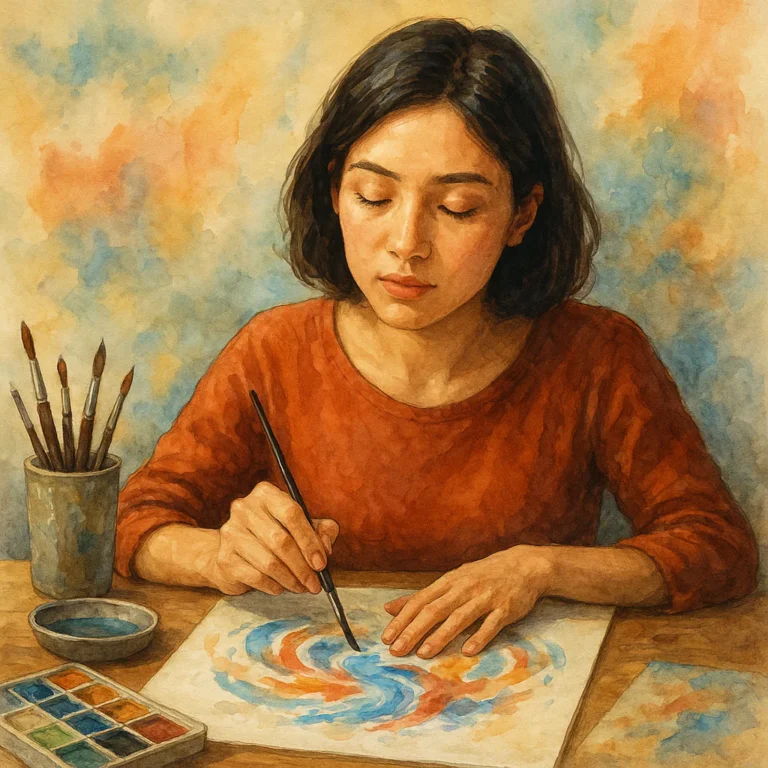
🎨 Mindful Art Therapy: Using Creativity as a Path to Clarity
Sometimes, words fail us. When the block is too deep for writing or talking, art becomes the language of the subconscious. Mindful Art Therapy isn’t about making a masterpiece; it’s about expressing the block itself.
The “Scribble” Technique
- Close your eyes.
- Scribble wildly on a piece of paper for 30 seconds.
- Open your eyes.
- Look at the scribble. What does it look like? A face? A landscape? A storm?
- Add to it. Turn the scribble into something.
- Why it works: It bypasses the logical brain and lets the hand lead.
The “Emotion Palette”
- Choose colors that represent your current frustration.
- Paint or draw those colors on a canvas.
- Now, choose colors that represent how you want to feel.
- Blend them. Watch how the colors interact.
- Insight: This visualizes the transition from block to flow.
Recommended Tools for Mindful Art
To get started, you don’t need a studio. Just a few essentials:
👉 CHECK PRICE on:
- Moleskine Watercolor Sketchbook: Amazon | Moleskine Official
- Prismacolor Premier Colored Pencils: Amazon | Prismacolor Official
- Crayola Washable Markers: Amazon | Crayola Official
Real Story: One of our clients, a graphic designer named Sarah, was stuck on a logo for weeks. She tried everything. Finally, she grabbed a red marker and just drew her frustration. The result was a chaotic red mess. But as she looked at it, she saw a shape that looked like a flame. That flame became the core of the logo. The block wasn’t a wall; it was a hidden door.
🧘 ♀️ Meditation for Writers, Designers, and Dreamers: Tailored Practices
One size does not fit all. A writer’s block feels different from a designer’s block. Let’s tailor the practice to your specific craft.
For Writers: The “Voice Memo” Meditation
Writers often get stuck in their heads, over-analyzing every word.
- The Practice: Instead of writing, speak. Record a voice memo of your stream of consciousness. Don’t edit. Just talk about the story, the characters, or your frustration.
- The Result: Hearing your own voice can unlock a rhythm that typing cannot.
For Designers: The “Visual Scan”
Designers get stuck on perfectionism and layout.
- The Practice: Close your eyes. Visualize your project. Now, imagine it broken. Imagine the colors wrong, the layout messy. Then, imagine it perfect.
- The Shift: By visualizing the “bad” version, you reduce the fear of making mistakes.
For Musicians: The “Silent Symphony”
Musicians often get stuck on melody or rhythm.
- The Practice: Sit in silence. Listen to the silence between the sounds. Imagine a melody playing in your head, but don’t try to write it down. Just let it float.
- The Insight: The music is already there; you just need to stop blocking it.
For All Creatives: The “Breath of Flow”
- Inhale for 4 counts.
- Hold for 4 counts.
- Exhale for 4 counts.
- Hold for 4 counts.
- Repeat for 5 minutes.
- Why: This box breathing technique calms the nervous system and prepares the brain for deep work.
Curiosity Check: You might be wondering, “Does this actually work, or is it just woo-woo?” The answer lies in the science of neuroplasticity.
🛌 Sleep, Stress, and the Silent Saboteurs of Your Imagination
You can meditate all day, but if you are running on cortisol and sleep deprivation, your creativity will remain on life support.
The Sleep-Creativity Connection
During REM sleep, your brain processes emotions and consolidates memories. This is when the brain makes those “wild” connections. If you skip sleep, you skip the creative processing.
- Fact: A study published in Nature found that sleep deprivation significantly reduces the ability to solve complex problems. Source: Nature
Stress: The Creativity Killer
Chronic stress keeps the brain in “fight or flight” mode. In this mode, the brain is focused on survival, not innovation.
- The Fix: You must lower your stress levels to access the DMN.
- Technique: Progressive Muscle Relaxation. Tense and release each muscle group from toes to head.
The Role of Burnout
Burnout is not just tiredness; it’s emotional exhaustion. It’s the result of giving too much without replenishing.
- Signs: Cynicism, detachment, feeling ineffective.
- Solution: Radical rest. Not “working less,” but doing nothing with intention.
The Hard Truth: You cannot hustle your way out of a creative block. Sometimes, the most productive thing you can do is sleep.
🍽️ Mindful Eating and Movement: Fueling the Creative Engine
Your brain is an organ, and like any engine, it needs the right fuel.
Mindful Eating for Focus
- The Problem: Eating while scrolling through social media or working leads to mindless consumption and brain fog.
- The Solution: Eat one meal a day without distractions. Chew slowly. Taste the food.
- Benefit: This practice improves digestion and mental clarity.
Movement as a Catalyst
- Yoga: Combines movement with breath, perfect for releasing physical tension.
- Walking: The “walking meeting” is a classic for a reason. The rhythmic motion of walking stimulates the brain.
- Dance: Let your body move to music. It breaks the mental loop.
Recommended Gear for Movement
👉 Shop Movement Gear on:
- Manduka PRO Yoga Mat: Amazon | Manduka Official
- Lulemon Align Legings: Amazon | Lulemon Official
- Garmin Venu 3 (for tracking movement): Amazon | Garmin Official
📱 Digital Detox: Reclaiming Your Focus in a Noisy World
We live in an age of constant distraction. Notifications, emails, and social media are the enemies of deep creative work.
The Dopamine Trap
Every “like” and notification gives you a hit of dopamine. This trains your brain to crave instant gratification, making deep work feel boring and difficult.
The “Single-Tasking” Challenge
Multitasking is a myth. It’s just rapid task-switching, which kills creativity.
- Practice: Pick one task. Do it for 25 minutes. No phone. No email. Just the task.
Digital Minimalism
- Audit: Delete apps you don’t use.
- Grayscale: Turn your phone screen to grayscale. It makes it less stimulating.
- Result: You reclaim your attention span.
Question: How long can you go without checking your phone? Try it for one hour. You might be surprised by how much mental space opens up.
🤝 Cultivating a Mindful Creative Community: You Are Not Alone
Creativity can be lonely. But you don’t have to do it alone.
The Power of Accountability
Find a creative buddy. Share your goals. Check in weekly.
- Benefit: Knowing someone is waiting for your work can push you past the block.
Mindful Critique Groups
Join a group where feedback is given with kindness and curiosity, not judgment.
- Rule: Start with “I like…” before “I wonder…”
Online Communities
- Reddit: r/creativity, r/writing, r/ArtFundamentals.
- Discord: Many creative servers offer daily prompts and support.
- Mindful Ideas™ Community: Join our Mental Health and Meditation Practices communities for support.
🛠️ Tools of the Trade: Apps, Journals, and Gear for the Mindful Creator
Let’s talk gear. The right tools can make the journey smoother.
Top Mindfulness Apps for Creatives
| App | Best For | Key Feature |
|---|---|---|
| Headspace | Beginners | “Focus” and “Creativity” packs. |
| Calm | Sleep & Relaxation | “Daily Calm” and nature sounds. |
| Insight Timer | Variety | Thousands of free meditations. |
| Waking Up | Deep Dive | Sam Harris’s approach to non-dual awareness. |
👉 Shop Apps on:
- Headspace: Amazon App Store | Headspace Official
- Calm: Apple App Store | Calm Official
- Insight Timer: Google Play | Insight Timer Official
Recommended Journals
- The Artist’s Way Journal: Based on Julia Cameron’s famous book.
- Moleskine Cahier Journal: Great for quick sketches and notes.
- Bullet Journal: For organizing your creative projects.
👉 Shop Journals on:
- The Artist’s Way: Amazon | Julia Cameron Official
- Moleskine Cahier: Amazon | Moleskine Official
💡 Quick Wins: 5-Minute Mindfulness Hacks for Immediate Inspiration
No time for a full meditation? Try these 5-minute hacks.
- The “One Breath” Reset: Take one deep breath. Hold it. Exhale slowly. Repeat 5 times.
- The “Name It” Game: Name 5 things you can see that are blue.
- The “Stretch” Break: Stand up and stretch your arms to the ceiling.
- The “Hum” Technique: Hum a low note. Feel the vibration in your chest.
- The “Water” Trick: Drink a glass of water slowly.
Why these work: They interrupt the stress response and bring you back to the present moment.
📊 Case Studies: How Top Creatives Overcame the Blank Page
Let’s look at real examples of how mindfulness transformed creative blocks.
Case Study 1: The Writer’s Block
Problem: A novelist couldn’t finish her third chapter.
Solution: She started a morning pages practice (3 pages of stream-of-consciousness writing every morning).
Result: The block dissolved. The “junk” writing cleared the path for the story.
Case Study 2: The Designer’s Stagnation
Problem: A graphic designer felt stuck in a rut.
Solution: She started walking without her phone every day.
Result: She started noticing patterns in nature that inspired a new design style.
Case Study 3: The Musician’s Silence
Problem: A composer couldn’t write a melody.
Solution: He practiced silent meditation for 20 minutes a day.
Result: The melodies started coming in his dreams.
The Common Thread: All three stopped trying and started being.
🎥 Featured Video: Guided Meditation for Creativity
We want to share a powerful resource with you. The video below offers a guided meditation specifically designed to boost creativity and inspiration.
Watch the Guided Meditation: Journey Through the Nebula
- What to expect: A visualization of floating through a nebula, connecting with limitless potential.
- Key Message: “In the midst of the process, clarity arises.”
- Takeaway: You can be blocked when you haven’t even started. The act of showing up is the first step.
Note: This practice emphasizes embracing imperfection. Your first draft doesn’t have to be perfect. It just has to exist.
❓ Frequently Asked Questions About Mindfulness and Creativity
How does mindfulness help overcome creative blocks?
Mindfulness helps by reducing the activity of the inner critic (the dorsolateral prefrontal cortex). It allows the brain to shift from a state of stress and judgment to a state of curiosity and openness. By observing thoughts without attachment, you create space for new ideas to emerge.
What are the best mindfulness exercises for artists?
The best exercises are those that engage the senses and bypass the logical brain. Sensory scavenger hunts, mindful drawing, and body scans are highly effective. The goal is to get out of your head and into your hands.
Can meditation unlock creativity when stuck?
Yes. Meditation calms the nervous system and activates the Default Mode Network, which is responsible for generating new ideas. However, it’s not a magic wand; it’s a tool that needs to be used consistently.
How long does it take for mindfulness to improve creative flow?
It varies. Some people feel a difference after one session. For others, it takes weeks of consistent practice to rewire the brain. The key is patience and consistency.
What are some quick mindfulness techniques for writers?
Free writing (writing without stopping), voice memos, and the “bad idea” brainstorm are great for writers. They help bypass the editor and get words on the page.
Does mindfulness reduce anxiety related to creative work?
Absolutely. Mindfulness reduces cortisol levels and helps you accept uncertainty. It teaches you that it’s okay to make mistakes, which reduces the fear of failure.
How can I use mindfulness to generate new ideas?
By practicing open monitoring meditation, you allow your mind to wander. This state is where random connections happen. You can also use visualization to imagine new possibilities.
🔗 Recommended Links and Resources
Here are some of our top picks to help you on your journey:
Books:
- The Artist’s Way by Julia Cameron: Amazon
- On Becoming An Artist by Ellen Langer: Amazon
- The Mindful Writer by Dinty W. Moore: Amazon
Apps:
- Headspace: Headspace Official
- Calm: Calm Official
- Insight Timer: Insight Timer Official
Tools:
- Moleskine Sketchbooks: Moleskine Official
- Prismacolor Pencils: Prismacolor Official
📚 Reference Links and Scientific Studies
- Harvard Health Publishing: The Default Mode Network and Creativity. Link
- Nature: Sleep and Creative Problem Solving. Link
- University of Utah: The Effects of Nature on Creativity. Link
- Alo Moves Blog: 10 Mindful Ways to Push Past Creative Blocks. Link
- Psychology Today: Mindfulness and the Art of Living Creatively. Link
- Headspace: Overcoming Creative Blocks. Link